Most Canadian darknet markets lasted a season. Wethenorth has been running since 2021 — through enforcement actions, DDoS waves, and the collapse of bigger platforms. This page covers where it came from and how it operates.
"WTN wasn't built to be the biggest. It was built for Canadians who were tired of markets that didn't understand domestic shipping."
— Community thread, October 2022
Canadian roots
Wethenorth launched in late 2021 with a narrow mandate: serve Canadian buyers and vendors exclusively. The platform's early vendor list was small — under 60 shops — but every one of them offered domestic shipping. No cross-border customs risk, no three-week waits, no packages traveling through US distribution centres where seizure rates were significantly higher.
The founding team had operated as vendors on Empire and AlphaBay before those platforms came down. They understood the practical problems: vendors constantly misrepresenting shipping times, buyers expecting American-market norms from Canadian geography, and dispute systems that didn't account for Canada Post's idiosyncrasies. Wethenorth was designed around those specifics.
The first six months ran invite-only. Applications required a PGP key and a referral from an existing member. That friction kept early disputes low — under 3.1% of orders — and established a vendor quality floor that has defined the platform since. Vendors who joined in 2022 and maintained their ratings are still among the highest-traffic shops today.
Public registration opened in April 2022. Within three months, registered user accounts crossed 28,000. By January 2023, Wethenorth had processed over 100,000 orders. Those numbers made it the highest-volume Canadian-focused darknet platform — a position it has held without interruption through 2026.
What sets it apart
Two design choices define the platform: domestic-first vendor requirements and escrow that doesn't hold vendor funds indefinitely.
The domestic shipping requirement isn't absolute — vendors can offer international as a secondary option — but the primary listing must be a Canadian shipping method. That single rule filters out a large category of vendors whose business model depends on customs arbitrage or who can't fulfill reliably to Canadian addresses.
The escrow system uses a modified finalize-early (FE) model with graduated trust. New buyers hold funds until confirmed delivery. Buyers with over 30 completed orders and a clean history can request FE from approved vendors. Vendors reach "approved" status after 200 successful orders with a rating above 4.3. The system rewards established relationships without eliminating protection for new participants.
Disputes are handled by a three-person staff team. Two reviewers and one arbiter. Decisions are issued within 72 hours for standard cases, 144 hours for contested cases requiring tracking evidence. In January 2026, the average resolution time was 51 hours.
Vendor standards
The vendor application process is more involved than most comparable platforms. New applications are reviewed by staff, not automatically approved.
Application review
Every vendor application includes a written statement of prior experience, a PGP-signed sample listing, and a product category declaration. Staff verify PGP key ownership before approving any application. The review takes between 48 and 96 hours.
Bond system
New vendors post a bond on opening. The amount scales with the category — higher-risk categories require larger bonds. The bond is fully refunded after 100 completed orders with no open disputes. Vendors who fail to maintain a 3.8 rating within the first 50 orders forfeit the bond.
Ongoing accountability
Vendor ratings are public and permanent. There is no rating reset on account transfer. If a shop changes hands, the rating history carries over. This prevents the common practice of selling burned accounts and relaunching with clean metrics.
Platform security
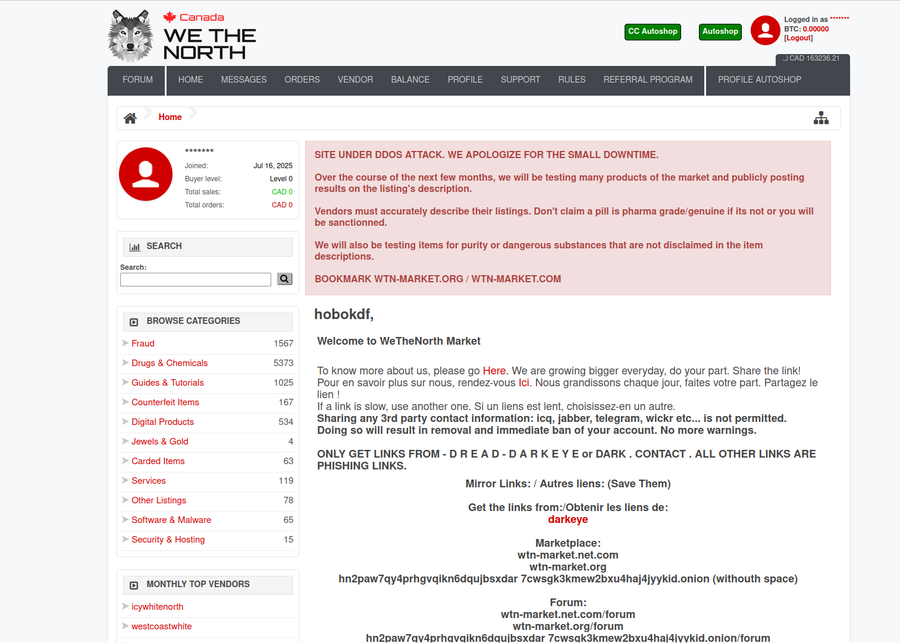
Wethenorth runs entirely over Tor. There is no clearnet version, no .com companion site, no mobile app. Any site claiming to be a Wethenorth "lite" or "mobile" interface is not affiliated with the platform.
Login uses a two-factor system: passphrase plus a time-based one-time password (TOTP) code. PGP encryption is mandatory for all order communications — the platform enforces this at the messaging layer and rejects unencrypted content in order threads. That requirement was added in March 2023 after two vendors were identified as operating under compromised accounts.
The platform maintains a public canary statement, updated every 30 days, signed with the admin PGP key. If the canary goes unsigned for more than 35 days, the community treats it as a signal of platform compromise or seizure. As of April 2026, all canary statements are current and signed.
Phishing clones are common. Fake Wethenorth mirrors appear regularly on clearnet search results and Tor directories. The verified address list on this directory is updated daily and checked against the PGP-signed announcement from the Wethenorth Dread subdread. Don't use any address that hasn't been through that verification chain.
Wethenorth's login screen includes a TOTP field and anti-phishing code visible only after initial account setup.
Platform timeline
Private launch
Invite-only, under 60 vendors, domestic shipping mandate from day one.
Public registration
Open to all buyers. Vendor applications remain reviewed manually. 28,000 accounts registered by July.
100,000th order
Milestone processed without platform outage. Dispute rate held at 3.4% — well within target range.
Mandatory PGP communications
Platform-enforced encryption on all order threads. Unencrypted messages rejected at the server level.
Mirror network expansion
Four onion mirrors added. Load balancing distributed across all mirrors to reduce single-point outage risk.
Current status
81,709 registered users, 3,241 active vendors, all mirrors operational, canary current.
Get the verified Wethenorth link
The address below is confirmed daily against the PGP-signed announcement. Copy it and open in Tor Browser only.